NewSmsPunch Chat Room

Showing posts with label creative writing. Show all posts

2019 Post #30 -- The Poetry of Prose

by Travis Crowder

One of the beautiful things about poetry is that is touches all other genres. Poetry dwells within prose, both fiction and nonfiction, sometimes subtle and other times striking, but always trying to nudge us past the ostensible. Authors use poetic language to move their writing and to help us see the world through their eyes. Words, the molecules of ideas, envelope us, nudging us to think deeply about their function. Sometimes they seem to rest in the palm of an open hand, inviting us to use and to lean on them, to pull them into our own way of writing and speaking. This part of author’s craft is majestic, and I love introducing students to how authors use words to convey meaning.

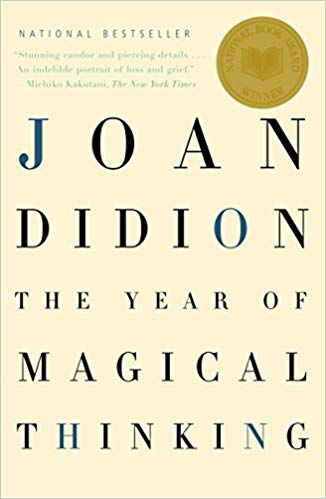
Just a few days ago, conversations about author’s craft centered around the use of short sentences in prose. I mentioned to students how powerful short sentences could be, but like many things in reading and writing, showing works better than telling. During independent reading, I asked them to collect short sentences (usually 1-4 words) form their books on sticky notes. I came to class with my own collection of short sentences from my book, The Year of Magical Thinking by Joan Didion, pictured here:
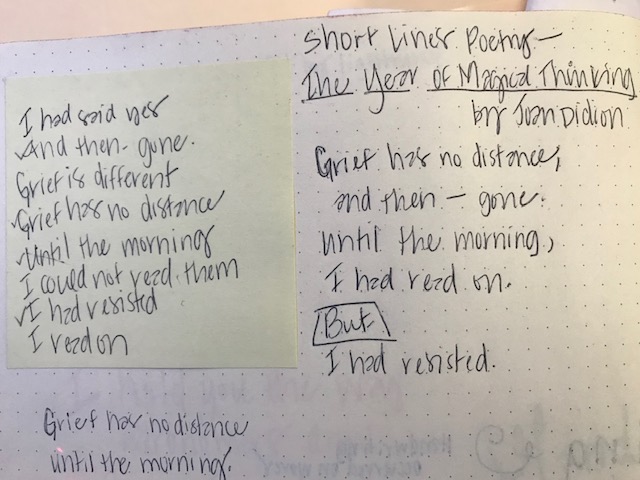


Under the document camera, I began arranging the sentences into the form of a poem, paying attention to the meanings of lines, of how fractured sentences could be fused into new ones, of how meaning changes when lines are extracted from context and blended with something else. As I arranged the sentences, I thought aloud, telling students that adding or removing words from the original sentences was acceptable.

After a few minutes of crafting in front of them, I invited them to do the same. Students worked for about ten minutes with the sentences from their independent reading. During this time, I asked them to mold them into the shape and feel of a poem, read it aloud to themselves, then revise their original poem by swapping lines, interspersing their own lines of original thought, isolating words on a single line to draw attention to them, and so on.

After collecting short sentences from Girl in Pieces by Kathleen Glasgow, Levi wrote:

I am alone.
In the house.
I let them pull me in.
Deep down.
Black as night.
Nothing in my mind.
I turn it off.
I stare at the computer.
Years goes by.
But I am not.
....... died.
In my mind.
I feel free.
But in my heart.
I am gone

The arrangement of sentences—filled with haunting lyricism—mesmerized me and his other readers.

Brittany, while reading Flawed by Cecilia Ahern, found this poem of sentences:

A light goes on for me.
I have people.
My hearing is this afternoon.
She makes a face.
I smile at her in thanks.
And then we are inside.
He tips his hat.
¨Do you agree?¨
I silently fume, then think hard.
¨Absolutely.¨
The room erupts.
I jump up.
I pass out.

The blend of dialogue gives her poem a different edge. Characters’ names were in the original version, but I encouraged her to remove them so the reader could create the voices and names. 

Finally, students shared their poems with a classmate and posted it on a class Padlet. I also shared mine.


Grief was different.
an ocean of dark
I could not read.
I had resisted,
but soon said yes,
and felt the rush
of numbing waves.
Grief has no distance
until the morning,
when streams of light
streak the sky.

Stretching Their Thinking
Creativity exploded with this activity. I wanted students to deepen their awareness of the utility of short sentences while also appreciating author’s craft. After students posted their poems on the Padlet, I gave them time to read their classmates’ poems, identifying the one they were drawn to the most. Inside their notebooks, they copied the poem and wrote their why: What caused them to choose this poem? What word or line stands out the most to them? How does this poem make you feel? Time was provided to share poems that resonated and to celebrate their craft.
I asked students to tell me how their thinking had changed about short sentences. They answered, “We had no idea short sentences could be so powerful.”

And now, they have beautiful poems and a method of reflection that they can return to again and again.

Further Reading:


Travis Crowder is a 7th grade ELA teacher in Hiddenite, NC, teaching ten years in both middle and high school settings. His main goal is to inspire a passion for reading and writing in students. You can follow his work on Twitter (@teachermantrav) and his blog: www.teachermantrav.com/blog.


2019 Post #28 -- A Concrete Clock Poem

by Brett Vogelsinger

When it comes to concrete poetry, students are often impressed with its combination of simplicity and cleverness.  And that's the thing about concrete poems: like masterful acrobats or skateboarders or dancers, they make artful maneuvers look easy.  As some people work on movement to play with gravity, the concrete poet plays with negative space, the blank page, and the shape of words in original and sometimes humorous ways. 

One of my favorite concrete poets is Bob Raczka and his book Wet Cement contains a poem that will ring true to students and teachers everywhere.  It is called "Clock" and the picture below comes from the Kindle preview on Amazon:  


Why not challenge your students to create a smiple clock poem that sets the hour and minute hands at a different time: wake-up time,  lunch, bedtime, game time.  Or you might challenge them to change the form and still write about time: a sundial, an hourglass, a digital clock, an iPhone.  This quick introduction to a sub-genre of poetry in a shape that students of all ages and artistic abilities can handle may do more than just inspire them to create a concrete poem.  Poetry is about moments, and this exercise moves them to think of a poemworthy moment.  Maybe the following day in class, that same moment can be crafted into a poem with line breaks and stanzas.  

The writer's notebook awaits!

Further Reading:


Brett Vogelsinger is a ninth-grade English teacher at Holicong Middle School in Bucks County, PA. He has been starting class with a poem each day for the past six years and is the creator of the Go Poems blog to share poetry reading and writing ideas with teachers around the world. Find him on Twitter @theVogelman.


2019 Post #27 -- Still Life

by Allison Marchetti

One of the greatest lessons we can give our young writers is to pay attention. Nature walks, writer’s notebooks, guided imagery--all of these are wonderful tools for sharpening the writer’s focus. Another tool is the still life in words.

Jim Daniel’s poem “Work Boots: Still Life” describes a pair of work boots drying in the sun. Like an artist painting the tiny details of a thing, each line reveals the hidden layers and larger-than-lifeness of an ordinary pair of boots. The poem builds to reveal much about its wearer, to whom the boots offer the “promise of safety | the promise of steel.”

Daniels’ poems make holy ordinary moments. They are snapshots of everyday life--brushing your teeth at the sink with your sister, a pair of workboots left to dry in the sun, reading in bed with your littles close--written in beautiful, simple language, and they reveal a hidden beauty that is there simply if you pay attention.

Lead your students in an exercise that will help them pay attention to something ordinary and paint a still life in words:

Choose an inanimate object in your bedroom or home that has some significance behind it: that pair of shoes you always reach for, the old hoodie, the stuffed animal you can’t bear to pack away.

Make a two column chart in your notebook. In the left-hand column, describe what you see in plain language. Like a painter, look closely, making your way around the entire object, seeing it from multiple angles. What’s there that you’ve haven’t noticed before, even though you’ve likely looked at it thousands of times? A tiny rip at the seem, some dried chocolate smeared by little hands?

In the right column, make a list of “deeper meanings”: think about what this object means to you, where you’ve used it, or worn it, memories associated with it, etc.

Use Jim Daniels’ poem to think about how you might pair each description with a deeper meaning. Play around with interesting and unexpected similes and metaphors that breathe life and story into this inanimate object.

Consider borrowing Daniels’ syntax in the last three lines: A ____________ reveals a ________, a __________, the ______________ to tie it all together.

Offer the option of bringing in a picture of the object and pairing it with the typed poem for a beautiful still life gallery walk in your classroom.

Further Reading


Allison Marchetti is co-author with Rebekah O’Dell of WRITING WITH MENTORS and BEYOND LITERARY ANALYSIS (Heineman). She is the co-founder of Moving Writers, a blog for secondary writing teachers. She lives with her family in Richmond, Virginia.

2019 Post #24 -- Reading and Writing Outdoors

by Sarah Mulhern Gross

Mary Oliver’s “The Summer Day” is one of my favorite poems to share with students. It’s one of Oliver’s best-known and most-quoted poems and has been included in a few of her anthologies. It strikes a chord with many high school students as they are beginning to think about their lives beyond high school. It’s also a great way to get students to slow down and observe nature for a few minutes.

Begin by giving students a copy of the poem and let them read along as they listen to Mary Oliver read it. I like to take my students outside for this activity, so I use my cell phone to share the audio. Ask your students to mark the phrases or lines that strike them in any way while they read the poem. After students have read the poem and listened to Oliver read it, have a brief discussion. I always point out to students that “The Summer Day” sounds like a prayer to me, and this makes sense because Oliver frequently talked about how the forest was her church. Ask students what their “church” might be. Where do they feel spiritual? Where do they feel safe and at peace?

After a brief discussion, give students a few minutes to write. Ask them to let the sights and sounds of the outdoors guide their writing as they try to answer the question “What is it you plan to do with your one wild and precious life?” I don’t give my students too many guidelines here as I just want them to write. Their response can be in prose or poetry form, and if they really get stuck I encourage them to sketch.

You could easily extend this activity into a full lesson by having students choose something outside (a tree, a blade of grass, a bird, a bug, etc) and center their response around it like Oliver centers her poem around the grasshopper. They could spend 10-15 minutes making observations about what they see, hear, smell, feel and (maybe?) taste while observing their species of choice. Oliver’s poem can serve as a mentor for their response to the question in her final line.

For more on Mary Oliver, check out this excellent New Yorker piece: Mary Oliver Helped Us Stay Amazed

For a brief Go Poems idea for Mary Oliver's "Wild Geese" click here.

Further reading:


Sarah Gross is one of the co-organizers of NerdCampNJ. She teaches in central New Jersey and loves spending time outdoors.

2019 Post #14 -- Pantoun Poems

by Kevin English

One of my favorite poems to write with students is the pantoum. The basic structure is as follows: ABCD, BEDF, EGFH, ACHJ. We read Carolyn Kizer's poem Parent's Pantoun.

Here is one that I wrote in front of my students:


On Public Announcements


If it can be said in an email, send it.
Announcements seem to interrupt my day.
The beep is an intruder that I can’t stop,
Robbing my students of focus.


Announcements seem to interrupt my day.
My blood pressure rises; I can’t make it stop.
Robbing my students of focus,
Me of valuable instructional time.


My blood pressure rises; I can’t make it stop.
It’s followed by chaos and the opening door,
Robbing me of valuable instructional time.
It’s a daily battle that I’m losing.


It’s followed by chaos and the opening door.
The class is now interrupted
It’s a daily battle that I’m losing,
A war of attrition on my patience.


And the concentrating class is now interrupted.
The beep is an intruder that I can’t stop.
A war of attrition on my patience
If it can be said in an email, send it.


What I like about pantoums is that they appear accessible to students. I share that you really are writing 9 lines and then repeating those lines. But repeating those lines is also what is complex, where the author must think about getting the lines in an order that makes sense. I do always begin by having students number (or letter) the lines on a lined sheet of paper. It helps the writer organize their thoughts and lines, especially when it comes to repeating them later.

I ask writers to think about a few things as they write and revise:


What line is the most important to begin on and end on?

As you brainstorm and draft, which lines are worthy of being repeated and which are not?

How can you leverage punctuation in a way that will introduce an idea in one line but have the same line conclude an idea later on?


Further Reading:


Kevin English is an assistant principal, former ELA teacher, school board member, avid reader, and NWP teacher consultant.  You can follow him on Twitter @KevinMEnglish

2019 Post #11-- A Stack of Similes

by Michael Salinger and Sara Holbrook


EDITOR’S NOTE: I’ve been a longtime fan of Michael and Sara’s work, and I am thrilled to present a poem they have written (based on an experience in Ghana!) and a lesson plan from their latest professional book, From Striving to Thriving: Strategies to Jump-start Writing, which I highly recommend. Enjoy! -- Brett


Bats!

Nocturnal
as a lightning bug.
Hanging like a tree fruit.
Beeping like a
smoke detector
Fuzzy as a hamster.
Face like a freeze-dried dog.
Tracking like a sonar.
Flapping like a novice in the deep end.
Megabat is me.

© 2019 Sara Holbrook and Michael Salinger, Dreaming BIG and Small, Streamline Press. ALL RIGHTS RESERVED

First, read poem "Bats!" and note it’s made up of a stack of similes, plus a last line that identifies the theme of the poem. Together, co-construct a list of action verbs to describe your classroom. Ask: What do you do (seventh) graders? Answers may include: read, text, chat, watch, dribble, run, laze, eat, etc.

Begin your co-construct by stating a theme: something like Room 206 is us, or eighth grader is me. Turn your action verbs into similes, adhering to the theme.

Label this Version 1. Remind writers that poets tell the truth; however, we also want to be a bit surprising. If a clichรฉ turns up in the Version 1, indicate that we will want to revise that in Version 2.
Next, ask students to come up with a theme for their own writing: Creative is me, an athlete is me, funny is me, etc.

Students can divide their papers like so for a pre-write: 

Ask students to first make a list of actions that pertain to their theme. Invite writers to make a stack of similes from their action verbs. Remind students to try and be surprising. "Fast as a cheetah," may be okay for Version 1, but we will want to be more original in our next version!

Ask students to transition to an electronic device or their writer’s notebooks to rearrange their simile stack into a poem.

© 2018 Sara Holbrook and Michael Salinger, From Striving to Thriving Writers, Strategies to Jump-start Writing, Scholastic.

Further Reading:


Learn more about Sara and Michael's work at www.saraholbrook.com and www.outspokenlit.com

2019 Post #1 -- Deleted Scenes from "Famous"

by Brett Vogelsinger

Welcome back teachers, poets, writers, and students to our first post of the 2019 National Poetry Month season!  Subscribe now via email so you can catch every post and add new selections to your repertoire of poems to share with students.  On this site, you will also find engaging methods, questions, and media to provoke powerful thinking in your classroom.

Naomi Shihab Nye is a familiar name to many teachers who share poetry in their classrooms. Her poems are accessible and profound. They balance provocative, relevant commentary on our world with a sense of joy and possibility that children need to hear in their reading at school.

Her poem "Famous" is one of her best-known poems, but the title is slyly misleading. Instead of celebrating fame in the red-carpet sense of the word, it turns an eye on commonplace things "like a pulley . . . or a buttonhole . . . because it never forgot what it could do."

After reading the poem with students, discuss this question: "What is she doing here with the title and the concept of fame?"  Then, in their notebooks, invite students to create an imaginary"deleted scene" from this poem that fits the spirit of the original.  They might begin with her refrain "The _______ is famous to the ________" to shine a light on a different sort of fame. The opening lines of the last two stanzas also work well for this prompt: "I want to be famous to _______" or "I want to be famous in the way ________." My students wrote about the "fame" of jeeps, staples, touchscreens, pen caps, and tree trunks in their notebooks, to name a few.

When you visit the link to today's poem, be sure to watch the film adaptation of Nye's poem at the bottom fo the page.  The creative pairing of video imagery with lines from the poem could spark a discussion all of its own.  In a later post, we will look at another video from the Poetry Foundation's Poem Movie collection.

Further Reading:


Brett Vogelsinger is a ninth-grade English teacher at Holicong Middle School in Bucks County, PA.  He has been starting class with a poem each day for the past six years and is the creator of the Go Poems blog to share poetry reading and writing ideas with teachers around the world. Find him on Twitter @theVogelman.

2018 Post #26 -- Take a Bite Out of Poetry

by Lauren Heimlich Foley

During a summer graduate class, I found myself re-inspired while participating in a poetry lesson modeled after Nancie Atwell’s writing-reading workshop. That afternoon, I dusted off Naming the World, making a promise to include more poetry the following school year.

Weeks later, I started a September class period with a poem by Ronald Wallace. To engage my students, I projected “You Can’t Write a Poem about McDonald’s” on the board and asked them what they thought.

Some groups, wanting to disprove the statement, created their own poems. Other tables believed McDonald’s was not an appropriate topic for a poem or would not make a strong writing piece. Still, others wondered if the clause was in fact a poem since quotation marks flanked both sides of it.

Once table groups shared their theories, I revealed that “You Can’t Write a Poem about McDonald’s” was indeed a poem. Students exclaimed phrases such as, “No way!” or “I told you so!” or “Really?” Intrigued by their enthusiasm, I wondered what their responses would be to the actual text.

After reading the poem and inviting students to share their highlighted lines, our room erupted with meaningful conversations. My nervous-unsure-second-week-of-school seventh graders transformed into investigators and analyzers. As I moved between groups, listening in on their discussions and asking questions to push their thoughts further, their commentary on diction, personification, imagery, similes, and symbolism led to dialogues on larger issues of consumerism, waste, world hunger, food accessibility, and the fast-food industry.

Additionally, we revisited “You Can’t Write a Poem about McDonald’s” during a later class period to discuss effective titles since my students’ initial reactions were so intense.

This poem’s ability to challenge my students’ beliefs of acceptable poetry topics while inviting them to take a platform through their own writing has made it one of my favorites.

Further Reading:


Lauren Heimlich Foley teaches seventh-grade English Language Arts at Holicong Middle School in Doylestown, PA.

2018 Poem #25 -- Reclaiming Identity

by Kelsey Hughes

Gwendolyn Brooks’s poem, “We Real Cool” is a perfect choice for the classroom for many reasons—its brevity (which is, of course, appealing to students at first glance) allows for deep-digging into a small space; the speaker’s voice is palpable and relevant to many teens; and the possibilities for connecting the poem’s themes and tone to a class novel are endless.

This year, I used “We Real Cool” when teaching S.E. Hinton’s The Outsiders. I presented the poem to students at the beginning of class and let Brooks read the poem herself (Listen here). Her introduction provides a good backstory before reading the poem, and by listening to Brooks read aloud, the students are able to benefit from hearing her rhythm and her voice as she reads the poem beautifully. The students then re-read the poem multiple times on their own, marking up the text each time through a new layer--be it through line-by-line extractions of meaning, notes about repetition and figurative language, or even insights into the poem’s progression. After ample time with the text, we “tear apart” and discuss the poem together on the SmartBoard.

After making sense of the poem in isolation, I then ask the students to make a connection between this poem and The Outsiders. I intentionally leave the question, “How does this poem connect to The Outsiders?” open-ended, as the connections range from connections of theme to tone and form. Students surprise me with the amount of meaningful connections they can make with this poem.

After discussing their connections, I then had them look at the definition of “reclaim”* and ask how the speaker here is reclaiming his identity. I then take them to the moment in The Outsiders where the Greasers are almost pronouncing their own “manifesto” before the big rumble; here, we closely read this excerpt and discuss how Greasers are “reclaiming” their identities and why they might need to do this.

A creative writing option would be to have students write a poem in which they reclaim their own identities. This could be a pastiche poem, where students utilize the form and the repetition of “We” or “I” to create their own manifesto. An added challenge would be to require the students to incorporate gradual shift in tone that Brooks creates in “We Real Cool.”

Further Reading:


Kelsey R. Hughes is a writer and English Teacher at Lenape and Holicong Middle Schools in Bucks County, Pennsylvania. Her published and unpublished works can be found at www.kelseyrhughes.weebly.com.


*reclaim: retrieve or recover (something previously lost, given, or paid); obtain the return of.

2018 Poem #22 -- Poetry Imitations

by Oona Marie Abrams


Poem imitations are gateway writing experiences, in which student poets borrow the bones of a poem’s structure, but put on flesh of their own. First, I like to share an imitation, drawn from a poem that we have already studied.  In this, I embed links to the original texts and credit the original poets. “My Brother’s Nails” is an imitation of Stanley Plumly’s “My Mother’s Feet.” By this point in the year, my students know I have a younger brother on the autism spectrum, but I share with them that poetry is my genre of choice when writing about him. Depending on the class, I might not use that imitation, but I have others!  Imitating “Hanging Fire” by Audre Lorde planted me firmly back in my days as a heartbroken college student. And imitating “The Writer” by Richard Wilbur captured a precious snapshot of my own child. Find time to share one imitation of your own prior to introducing this activity to the students. If you feel vulnerable doing so, good! Now you know how your students feel every time they share their writing with you.


Natasha Trethewey’s poem “History Lesson” is ideal, since it provides both accessibility and challenge. Students can draft an imitation of one or more stanzas of the poem in ten minutes. Here is an example of one imitation from a student, adhering strictly to Trethewey’s original form. Another example is written by a student over a longer period of time. He used the poem more as “training wheels,” which then launched him on a longer poem. It’s worth mentioning that the two student poets above are both introverted. All the more reason why they should be given opportunities to discover (and quietly celebrate!) their own unique writing voices.

Further Reading:


Oona Marie Abrams (@oonziela) is one of the co-organizers of NerdCampNJ. She lives and teaches in northern New Jersey.

2018 Poem #21 -- Comfort Food

by Brett Vogelsinger

Everybody has their favorite comfort food. An omelette with bacon, macaroni and cheese, wonton soup, chocolate cake with vanilla icing, and a full box of Triscuits -- these are a few of my personal favorites.  

In the poem "Everybody Made Soups," poet Lisa Coffman takes an artistic eye to a favorite winter comfort food, and since winter does  not seem to want to let go of us here in Pennsylvania this year, it seems strangely apropos right now.  After a first read of the poem, I ask students to answer a single question.  What words or phrases do you find here that are most surprising to find in a poem about soup?


Everybody Made Soups
by Lisa Coffman

After it all, the events of the holidays,
the dinner tables passing like great ships,
everybody made soups for a while.
Cooked and cooked until the broth kept
the story of the onion, the weeping meat.
It was over, the year was spent, the new one
had yet to make its demands on us,
each day lay in the dark like a folded letter.
Then out of it all we made one final thing
out of the bounty that had not always filled us,
out of the ruined cathedral carcass of the turkey,
the limp celery chopped back into plenty,
the fish head, the spine. Out of the rejected,
the passed over, never the object of love.
It was as if all the pageantry had been for this:
the quiet after, the simmered light,
the soothing shapes our mouths made as we tasted.


Words and phrases like "great ships," "the story of the onion," "weeping," "cathedral," and "pageantry" consistently surprise my students.  We often end up discussing the fun choice of ending the poem with the image of "the soothing shapes our mouths made as we tasted."  I even ask them to pantomime what it looks like to eat a spoonful of soup. 

A follow-up question can help us go deeper and inspire writing: Why does the writer use words that seem almost too profound or intense for the topic?  How does this help strengthen the poem? 

For five minutes, students can write in their notebooks about a favorite comfort food, perhaps even using language that is a bit over-the-top to intensify the effect on readers.  Writing with them in my notebook under the document camera, I might zoom in on the "lava flows" when I slice open my omelette or capture the feeling of "base jumping" off the "cliff" of a three-layered chocolate cake slice.  These subtle hyperboles can make the mundane become extraordinary, and often that is the ambition of a poem in the first place. 

Further Reading: 


Brett Vogelsinger is a ninth-grade English teacher at Holicong Middle School in Bucks County, PA.  He is the faculty adviser for the school literary magazine, Sevenatenine.  Besides his annual blogging adventure on this site, he has published work on Nerdy Book Club, The New York Times Learning Network, and Edutopia and you can follow him on Twitter (@theVogelman).


2018 Poem #18 -- Through New Eyes

by Jason Stephenson

I read Cynthia Rylant’s picture book When I Was Young in the Mountains to my creative writing students during our memoir unit. I smile at the fact that the book was published in 1982, the same year I was born. As I teach high school, I am fairly unfamiliar with children’s book authors, so I was surprised to find another Rylant book on vacation in Houston one recent summer. The slim poetry collection, published in 2003, was titled God Went to Beauty School. In 23 poems over 56 pages, Rylant portrays God as a regular human with titles such as “God Got a Dog,” “God Made Spaghetti,” and “God Went to India.”

The titular poem, “God Went to Beauty School” opens the book. It is one long stanza with short line breaks, a dash of humor, and one simile. I read the poem aloud to my students and give them time to discuss it with an elbow partner. My Creative Writing 2 students rarely need prompting, but possible questions include:
  • What is so powerful about a human hand? 
  • How do you respond to God being described as a human? 
  • Was this poem blasphemous?
As a class, we discuss how the poem begins with short sentences but ends with one long, complicated sentence. The discussion of hands might lead us to the Michelangelo painting of the Creation of Adam, with God’s and Adam’s hands stretched out to one another. Even in the Bible Belt, most of my students are entertained and not offended by this poem.

My students write their own God-as-human poems in response: “God Got a Speeding Ticket,” “God Plays Golf,” and “God Bought a Gun,” just to name a few. We focus on emulating Rylant’s straightforward style, crisp line breaks, and deep insight.

Further Reading:


Jason Stephenson teaches creative writing at Deer Creek High School in Edmond, Oklahoma. He blogs infrequently at dcjason.wordpress.com.

2018 Poem #16 -- Powers of Observation

by Molly Rickert

Part of what make's Ada Limon's poem "The Conditional" exceptional is its use of figurative language, and I would like my students to become more comfortable with figurative language as a writing skill.

When we discuss the beauty and unique style of writing with figurative language, I have students write observation poems. The first goal is to make literal observations three times in a row: 1. Look up and write 2. Look around and write. 3. Look down and write.

Below is an example of the first stanza of a literal observation poem based on 1) the details of the ceiling tiles 2) what was nearby on a desk and 3) what was on the floor.


Students can repeat this process up to 3 times if they’d like (look up, look around, look down).

Then, I have students go through the same process, but this time, making only figurative observations. Below is an example of the first stanza of a figurative observation poem based on the same observations above 1) the details of the ceiling tiles 2) what was nearby on a desk and 3) what was on the floor.


For as many literal observations as the students made, I have them make the same amount of figurative observations.


After students draft their literal and figurative observations poems, we focus on students’ figurative observations, taking note of the unique comparisons, imaginative descriptions, and humorous interpretations. This often leads to a discussion of the power of figurative language and the freedom and creativity that can be used to enhance a point. We compare the literal observation poem with the figurative observation poem and discuss impact figurative language can have in writing.

Further Reading:


Molly Rickert is a seventh grade English teacher at Holicong Middle School. This idea was inspired by a class she took through the West Chester Writing Institute (PAWLP).  Follow her on Twitter (@itsklinemk).

2018 Poem #15 -- Personfication In Song

by Rita Kenefic

Many students have difficulty identifying  the various figures of speech. The lyrics to the song, "April, Come She Will" by Simon and Garfunkel are a wonderful example of personification  and can serve as a great way to reinforce this particular figure of speech. Additionally, I’ve found that students often don’t realize that song lyrics are actually poems. Once they understand this, it is likely to pique their interest in poetry.

First, copy the lyrics to "April, Come She Will" and distribute to students. Let students follow the lyrics, as you play the song.


Discuss how the lyrics personify the various months. Solicit students’ opinions of the effect the use of personification has on the poem.
Next, either suggest or have students brainstorm other categories that lend themselves to this kind of personification. Some examples are:  days of the week, holidays, seasons, decades of our life, etc.
Working either individually or in pairs, have students  pick a topic and write examples of personification in their writer's notebooks, using the song lyrics as a mentor text.
To follow up, you might encourage students to work on and complete their poems during independent writing time and share completed poems in some manner. Or you might choose to invite students to look at song lyrics as poems by identifying and sharing a song lyric that speaks to them.

Further Reading:


Rita Kenefic recently retired from position as a reading specialist in Central Bucks School District. Passionate about reading, writing and fostering literacy in the home.  Blogs at “Nurturing Literacy” http://www.helpurchildread.com/


NewSmsPunch | Send Free Sms Online in Pakistan | Comedy | Good Morning | Adult | Romantic | Birthday © 2012 | Powered by chattinghome.blogspot.com Specially Made for public chat rooms