NewSmsPunch Chat Room

Showing posts with label mentor text. Show all posts

2019 Post #28 -- A Concrete Clock Poem

by Brett Vogelsinger

When it comes to concrete poetry, students are often impressed with its combination of simplicity and cleverness.  And that's the thing about concrete poems: like masterful acrobats or skateboarders or dancers, they make artful maneuvers look easy.  As some people work on movement to play with gravity, the concrete poet plays with negative space, the blank page, and the shape of words in original and sometimes humorous ways. 

One of my favorite concrete poets is Bob Raczka and his book Wet Cement contains a poem that will ring true to students and teachers everywhere.  It is called "Clock" and the picture below comes from the Kindle preview on Amazon:  


Why not challenge your students to create a smiple clock poem that sets the hour and minute hands at a different time: wake-up time,  lunch, bedtime, game time.  Or you might challenge them to change the form and still write about time: a sundial, an hourglass, a digital clock, an iPhone.  This quick introduction to a sub-genre of poetry in a shape that students of all ages and artistic abilities can handle may do more than just inspire them to create a concrete poem.  Poetry is about moments, and this exercise moves them to think of a poemworthy moment.  Maybe the following day in class, that same moment can be crafted into a poem with line breaks and stanzas.  

The writer's notebook awaits!

Further Reading:


Brett Vogelsinger is a ninth-grade English teacher at Holicong Middle School in Bucks County, PA. He has been starting class with a poem each day for the past six years and is the creator of the Go Poems blog to share poetry reading and writing ideas with teachers around the world. Find him on Twitter @theVogelman.


2019 Post #27 -- Still Life

by Allison Marchetti

One of the greatest lessons we can give our young writers is to pay attention. Nature walks, writer’s notebooks, guided imagery--all of these are wonderful tools for sharpening the writer’s focus. Another tool is the still life in words.

Jim Daniel’s poem “Work Boots: Still Life” describes a pair of work boots drying in the sun. Like an artist painting the tiny details of a thing, each line reveals the hidden layers and larger-than-lifeness of an ordinary pair of boots. The poem builds to reveal much about its wearer, to whom the boots offer the “promise of safety | the promise of steel.”

Daniels’ poems make holy ordinary moments. They are snapshots of everyday life--brushing your teeth at the sink with your sister, a pair of workboots left to dry in the sun, reading in bed with your littles close--written in beautiful, simple language, and they reveal a hidden beauty that is there simply if you pay attention.

Lead your students in an exercise that will help them pay attention to something ordinary and paint a still life in words:

Choose an inanimate object in your bedroom or home that has some significance behind it: that pair of shoes you always reach for, the old hoodie, the stuffed animal you can’t bear to pack away.

Make a two column chart in your notebook. In the left-hand column, describe what you see in plain language. Like a painter, look closely, making your way around the entire object, seeing it from multiple angles. What’s there that you’ve haven’t noticed before, even though you’ve likely looked at it thousands of times? A tiny rip at the seem, some dried chocolate smeared by little hands?

In the right column, make a list of “deeper meanings”: think about what this object means to you, where you’ve used it, or worn it, memories associated with it, etc.

Use Jim Daniels’ poem to think about how you might pair each description with a deeper meaning. Play around with interesting and unexpected similes and metaphors that breathe life and story into this inanimate object.

Consider borrowing Daniels’ syntax in the last three lines: A ____________ reveals a ________, a __________, the ______________ to tie it all together.

Offer the option of bringing in a picture of the object and pairing it with the typed poem for a beautiful still life gallery walk in your classroom.

Further Reading


Allison Marchetti is co-author with Rebekah O’Dell of WRITING WITH MENTORS and BEYOND LITERARY ANALYSIS (Heineman). She is the co-founder of Moving Writers, a blog for secondary writing teachers. She lives with her family in Richmond, Virginia.

2019 Post #18 -- Where Are You From?

by Chris Kehan 

Where are you from? What makes you who you are? George Ella Lyon’s poem "Where I’m From" helps us get to the heart of that question. You can pose these questions to your students prior to reading the poem or after. Model on chart paper your list. Have them jot in their Writer’s Notebooks the answers. For students who may need more support have them split the page into 4 quadrants and label each one: family, friends, hobbies/interests, childhood experiences.

Have your students listen to George Ella read the poem aloud herself from her website. It gives authenticity and voice to the poem for your students to hear. Talk about how she "shows" rather than "tells" about where she’s from. Have a discussion with your students about what they think about where she’s from based off the stanzas. Point out the use of repetition (I’m from) at the start of various lines. 
 
Model writing a stanza from your list. Then allow your students time to write their own Where I’m From poems using her framework. Have them partner up to see if they showed where they’re from rather than telling. (Example: Not, I’m from basketball - Rather, I’m from sneakers screeching on the shiny court.) 

Point out the metaphor ending she uses. Brainstorm other metaphors to which life can be compared (i.e. book, ocean, flower, etc.). Model writing one. Have students try writing different metaphorical endings in their Writer’s Notebooks.

This poem is great to use at any point in the school year as it gives you and your students an opportunity to get to know one another and work on the craft of showing and not telling to describe where they’re from.

Further Reading:


Chris Kehan is a Library Media Specialist in the Central Bucks School District and a proud fellow of PAWLP (PA Writing & Literature Project) whose passion is teaching reading and writing to all grade levels and ages. Follow her on Twitter @CBckehan


2019 Post #14 -- Pantoun Poems

by Kevin English

One of my favorite poems to write with students is the pantoum. The basic structure is as follows: ABCD, BEDF, EGFH, ACHJ. We read Carolyn Kizer's poem Parent's Pantoun.

Here is one that I wrote in front of my students:


On Public Announcements


If it can be said in an email, send it.
Announcements seem to interrupt my day.
The beep is an intruder that I can’t stop,
Robbing my students of focus.


Announcements seem to interrupt my day.
My blood pressure rises; I can’t make it stop.
Robbing my students of focus,
Me of valuable instructional time.


My blood pressure rises; I can’t make it stop.
It’s followed by chaos and the opening door,
Robbing me of valuable instructional time.
It’s a daily battle that I’m losing.


It’s followed by chaos and the opening door.
The class is now interrupted
It’s a daily battle that I’m losing,
A war of attrition on my patience.


And the concentrating class is now interrupted.
The beep is an intruder that I can’t stop.
A war of attrition on my patience
If it can be said in an email, send it.


What I like about pantoums is that they appear accessible to students. I share that you really are writing 9 lines and then repeating those lines. But repeating those lines is also what is complex, where the author must think about getting the lines in an order that makes sense. I do always begin by having students number (or letter) the lines on a lined sheet of paper. It helps the writer organize their thoughts and lines, especially when it comes to repeating them later.

I ask writers to think about a few things as they write and revise:


What line is the most important to begin on and end on?

As you brainstorm and draft, which lines are worthy of being repeated and which are not?

How can you leverage punctuation in a way that will introduce an idea in one line but have the same line conclude an idea later on?


Further Reading:


Kevin English is an assistant principal, former ELA teacher, school board member, avid reader, and NWP teacher consultant.  You can follow him on Twitter @KevinMEnglish

2019 Post #1 -- Deleted Scenes from "Famous"

by Brett Vogelsinger

Welcome back teachers, poets, writers, and students to our first post of the 2019 National Poetry Month season!  Subscribe now via email so you can catch every post and add new selections to your repertoire of poems to share with students.  On this site, you will also find engaging methods, questions, and media to provoke powerful thinking in your classroom.

Naomi Shihab Nye is a familiar name to many teachers who share poetry in their classrooms. Her poems are accessible and profound. They balance provocative, relevant commentary on our world with a sense of joy and possibility that children need to hear in their reading at school.

Her poem "Famous" is one of her best-known poems, but the title is slyly misleading. Instead of celebrating fame in the red-carpet sense of the word, it turns an eye on commonplace things "like a pulley . . . or a buttonhole . . . because it never forgot what it could do."

After reading the poem with students, discuss this question: "What is she doing here with the title and the concept of fame?"  Then, in their notebooks, invite students to create an imaginary"deleted scene" from this poem that fits the spirit of the original.  They might begin with her refrain "The _______ is famous to the ________" to shine a light on a different sort of fame. The opening lines of the last two stanzas also work well for this prompt: "I want to be famous to _______" or "I want to be famous in the way ________." My students wrote about the "fame" of jeeps, staples, touchscreens, pen caps, and tree trunks in their notebooks, to name a few.

When you visit the link to today's poem, be sure to watch the film adaptation of Nye's poem at the bottom fo the page.  The creative pairing of video imagery with lines from the poem could spark a discussion all of its own.  In a later post, we will look at another video from the Poetry Foundation's Poem Movie collection.

Further Reading:


Brett Vogelsinger is a ninth-grade English teacher at Holicong Middle School in Bucks County, PA.  He has been starting class with a poem each day for the past six years and is the creator of the Go Poems blog to share poetry reading and writing ideas with teachers around the world. Find him on Twitter @theVogelman.

2018 Poem #22 -- Poetry Imitations

by Oona Marie Abrams


Poem imitations are gateway writing experiences, in which student poets borrow the bones of a poem’s structure, but put on flesh of their own. First, I like to share an imitation, drawn from a poem that we have already studied.  In this, I embed links to the original texts and credit the original poets. “My Brother’s Nails” is an imitation of Stanley Plumly’s “My Mother’s Feet.” By this point in the year, my students know I have a younger brother on the autism spectrum, but I share with them that poetry is my genre of choice when writing about him. Depending on the class, I might not use that imitation, but I have others!  Imitating “Hanging Fire” by Audre Lorde planted me firmly back in my days as a heartbroken college student. And imitating “The Writer” by Richard Wilbur captured a precious snapshot of my own child. Find time to share one imitation of your own prior to introducing this activity to the students. If you feel vulnerable doing so, good! Now you know how your students feel every time they share their writing with you.


Natasha Trethewey’s poem “History Lesson” is ideal, since it provides both accessibility and challenge. Students can draft an imitation of one or more stanzas of the poem in ten minutes. Here is an example of one imitation from a student, adhering strictly to Trethewey’s original form. Another example is written by a student over a longer period of time. He used the poem more as “training wheels,” which then launched him on a longer poem. It’s worth mentioning that the two student poets above are both introverted. All the more reason why they should be given opportunities to discover (and quietly celebrate!) their own unique writing voices.

Further Reading:


Oona Marie Abrams (@oonziela) is one of the co-organizers of NerdCampNJ. She lives and teaches in northern New Jersey.

2018 Poem #16 -- Powers of Observation

by Molly Rickert

Part of what make's Ada Limon's poem "The Conditional" exceptional is its use of figurative language, and I would like my students to become more comfortable with figurative language as a writing skill.

When we discuss the beauty and unique style of writing with figurative language, I have students write observation poems. The first goal is to make literal observations three times in a row: 1. Look up and write 2. Look around and write. 3. Look down and write.

Below is an example of the first stanza of a literal observation poem based on 1) the details of the ceiling tiles 2) what was nearby on a desk and 3) what was on the floor.


Students can repeat this process up to 3 times if they’d like (look up, look around, look down).

Then, I have students go through the same process, but this time, making only figurative observations. Below is an example of the first stanza of a figurative observation poem based on the same observations above 1) the details of the ceiling tiles 2) what was nearby on a desk and 3) what was on the floor.


For as many literal observations as the students made, I have them make the same amount of figurative observations.


After students draft their literal and figurative observations poems, we focus on students’ figurative observations, taking note of the unique comparisons, imaginative descriptions, and humorous interpretations. This often leads to a discussion of the power of figurative language and the freedom and creativity that can be used to enhance a point. We compare the literal observation poem with the figurative observation poem and discuss impact figurative language can have in writing.

Further Reading:


Molly Rickert is a seventh grade English teacher at Holicong Middle School. This idea was inspired by a class she took through the West Chester Writing Institute (PAWLP).  Follow her on Twitter (@itsklinemk).

2018 Poem #15 -- Personfication In Song

by Rita Kenefic

Many students have difficulty identifying  the various figures of speech. The lyrics to the song, "April, Come She Will" by Simon and Garfunkel are a wonderful example of personification  and can serve as a great way to reinforce this particular figure of speech. Additionally, I’ve found that students often don’t realize that song lyrics are actually poems. Once they understand this, it is likely to pique their interest in poetry.

First, copy the lyrics to "April, Come She Will" and distribute to students. Let students follow the lyrics, as you play the song.


Discuss how the lyrics personify the various months. Solicit students’ opinions of the effect the use of personification has on the poem.
Next, either suggest or have students brainstorm other categories that lend themselves to this kind of personification. Some examples are:  days of the week, holidays, seasons, decades of our life, etc.
Working either individually or in pairs, have students  pick a topic and write examples of personification in their writer's notebooks, using the song lyrics as a mentor text.
To follow up, you might encourage students to work on and complete their poems during independent writing time and share completed poems in some manner. Or you might choose to invite students to look at song lyrics as poems by identifying and sharing a song lyric that speaks to them.

Further Reading:


Rita Kenefic recently retired from position as a reading specialist in Central Bucks School District. Passionate about reading, writing and fostering literacy in the home.  Blogs at “Nurturing Literacy” http://www.helpurchildread.com/


2018 Poem #12 -- Letter to the Future

by Tyler Kline

In this exercise, students write a letter to a person living fifty years in the future.  First, read Matthew Olzmann's poem “Letter to Someone Living Fifty Years From Now” as a mentor text.

Students may write the letter to a specific person or to an anonymous "someone" like Olzmann does.  Encourage students to consider what they want to tell this person living in the future with some of the following prompts:  Do you want to share information about what is going on in the world right now?   Current events?  Celebrity gossip?  Do you want to share a fear, dream, wish or thought that you currently have?  Remind students that their letter do not have to be about anything monumental (example: Olzmann writes about animals becoming extinct) but what students write about should be significant to THEM.

As they write, encourage students to include a question to the future reader, something they would like to know from this person.  For example: "Do you still have the McDonald's Dollar Menu?" or "Who is on the one-hundred-dollar bill?" or "Are robots friendly?"

Olzmann ends his poem with the powerful line, "And then all the bees were dead."  Students can choose to end on any type of note they want -- inspiring, hopeful, forlorn, confused, etc.  Whatever their choice, encourage students to craft a last line that is as impactful as possible and to write this line in a separate stanza.

If time permits for discussion, students can share their poems with a partner.  The conference partner can pretend to be the reader fifty years from now and predict how this future reader would respond to the poem. 

Further Reading:


Tyler Kline is a teacher and writer from Pennsylvania.  In 2015, he was named the Poet Laureate of Bucks County, PA. 

Poem #9 -- As Easy As ABC . . . Or As Challenging

by Brett Vogelsinger

An abecedary is an inscription of the letters of the alphabet, often in order, and often used as a practice exercise, so technically every student who has studied the English language has completed an abecedary at some point early on in their education in order to learn the alphabet.  In fact, there is even a related word to describe people learning the alphabet: abecedarians.  That sounds so much more accomplished than "kindergarteners," does it not?

Gabriel Fried's poem, "Abecedary," is somewhat more challenging.  Each word begins with a consecutive letter of the alphabet, yet it makes fantastic, whimsical sense as a series of commands or instructions for debonair elves and mighty newish otters.

Here is the poem:

Abecedary
by Gabriel Fried

Apple-
Bodied
Child,
Debonair
Elf,
Forage
Gently
Here
In
Jasmine
Keeled
Latitudes.
Mighty
Newish
Otter,
Pray
Quietly.
Retrieve
Sapphires.
Trundle
Under
Violets
Within
Xanadu,
Young
Zodiac.


The poem looks like it must have been easy to write at first, much like some abstract paintings in a museum may make some visitors feel like, "Well I can do that!"  So challenge students to create an abecedary that makes some sense, maybe even as a set of instructions like this poem.  In five minutes, they will discover the challenge.

The goal here is not for every student to complete a perfect Abecedary, but rather to grapple in their writer's notebooks with this structure and see how an excellent poet can make a challenge look deceptively simple.

Further Reading:


Brett Vogelsinger is a ninth-grade English teacher at Holicong Middle School in Bucks County, PA.  He is the faculty adviser for the school literary magazine, Sevenatenine.  Besides his annual blogging adventure on this site, he has published work on Nerdy Book Club, The New York Times Learning Network, and Edutopia and you can follow him on Twitter (@theVogelman).

2018 Poem #8 -- The Power of Poetry

by Travis Crowder

So often, I find that students have a tenuous relationship with poetry. I expose students all year to poems, showing them how to unpack, create, and write about the things that are meaningful to them, the things that interest them. Most often, I find that students will grapple with more difficult poems if they have been given the opportunity to write their own.


Writing their own poetry, though, requires patience and guidance, especially if you work with reluctant readers and writers. I find that many students love writing in non-traditional formats, especially concrete poetry. I introduce nontraditional poetry early in the year, and as the year progresses, I give students chances to write poems that break traditional forms. I love using Allan Wolf’s writing as a starting point because he is an accessible poet, but he also deconstructs traditional forms to engage readers.  


I ask students to jot down these questions…


1. What do I see?
2. What do I hear?
3. What do I feel?
4. What do I smell?
5. What do I think?

...and begin adding their thinking.


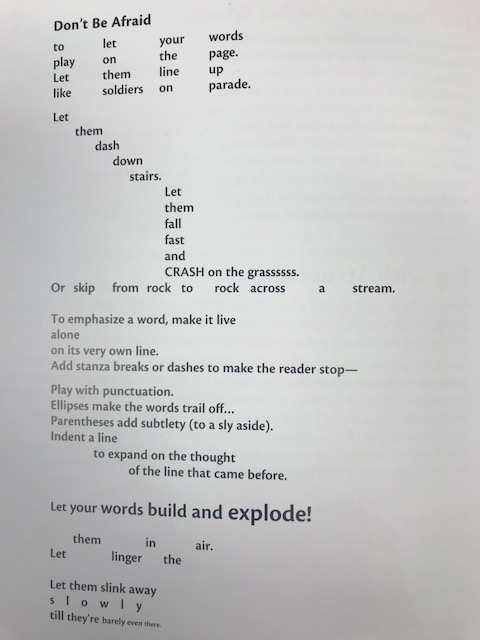
Afterward, I display "Don't Be Afraid" by Allan Wolf. It is a segment from Immersed in Verse, a beautiful book of lyricism that invites any writer into the world of writing poetry.

Image taken from Allan Wolf's website, linked above. 

For a few minutes, we discuss how Wolf modifies font size, style, and spacing to match topics and ideas within his poems. Students are always mesmerized by the variations in style and are eager to create their own.


So I let them. And they use the things they saw, heard, felt, smelled, and thought as the foundation for their poems.   


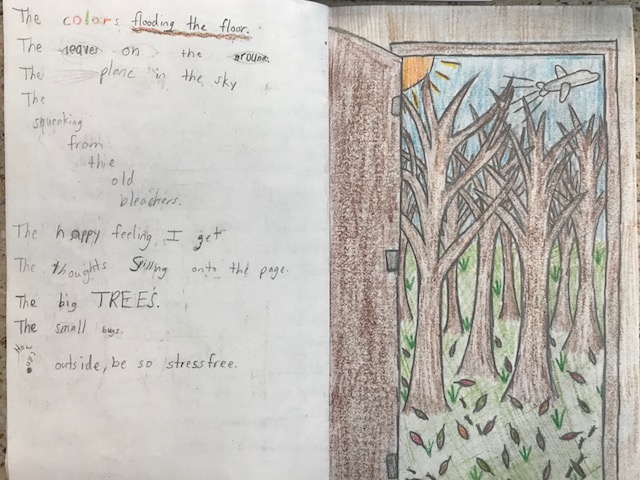
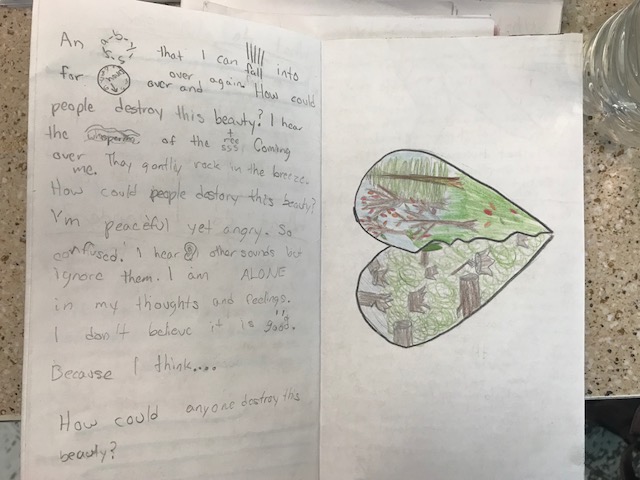
I give them time to play with language, with style, with spacing, and with imagery, much like the poem from Allan Wolf. It is here that students begin to understand purpose, tone, and how poetry can push us past the ostensible. Give them a chance to create. And be prepared to stand in awe of their creations, such as the examples below:


Further Reading:


Travis Crowder is a 7th grade ELA teacher in Hiddenite, NC, teaching ten years in both middle and high school settings. His main goal is to inspire a passion for reading and writing in students. You can follow his work on Twitter (@teachermantrav) and his blog: www.teachermantrav.com/blog.

Go Poem #27 -- Wreck This Poem

by Brett Vogelsinger

As teachers of poetry, we have likely all spoken about the value of each word in a poem.  It is no hyperbole to say that each word in a poem carries more weight than each word in an essay, short story, or novel.  But to make this fact have a bit more impact, and in the spirit of Keri Smith's wildly successful creative journal series, it can be fun to experiment with "wrecking" a poem.

Anne Porter's Poem "Wild Geese Alighting on a Lake" is a poem that students can easily identify as tranquil in its mood.  I challenge students to wreck the poem in their Writer's Notebooks by drastically altering its mood.  They must do this by changing only five words.

Fair warning: if you try this in class, a fair amount of students will kill off those geese.  Nonetheless, the outcomes are remarkable.  A poem that is nearly the same can be so, so, incredibly different when the writer (student) alters just five of the writer's (poet's) words.  Your class is guaranteed a few laughs along the way, and we can only hope that Anne Porter would forgive and maybe even applaud the kids' irreverent ingenuity.

An interesting extension might include a discussion of the connotations of those five changed words, for it is the associations of the individual words that help to craft the mood in a poem.

Brett Vogelsinger teaches freshman English students at Holicong Middle School in Doylestown, PA where he starts class with a poem each day. Follow his work on Twitter @theVogelman.

Further Reading:

Living Things: Collected Poems by Anne Porter


Go Poem #21 -- A Seasonal Switch-Up

by Brett Vogelsinger

National Poetry Month is a harbinger of warmer weather in many parts of the United States, and most people who experience the bitter extremes of a frigid winter are ready to bid that weather farewell.  Reading the poem "Night Below Zero" by Kenneth Rexroth might seem counterintuitive.

The poem beautifully captures the way "the cold lies, crystalline and silent" in the dead of winter, which can introduce an intriguing challenge for your students.  Can they craft a short, sharp poem like this one that captures the awakening of new life with the first warmth of spring?

When the first beautiful weather strikes in Pennsylvania, I share with my students the line from Gerard Manley Hopkins' poem, "Spring": "when weeds in wheels spring long and lovely and lush."  How amazing is the rhythm and alliteration in that line!  But I digress.

Why not take the poem's title in today's poem, "Night Below Zero" and change it to something in the same concise structure that captures a key element of spring in your community:  "Sunrise Before Alarm Clock" or "Buds Upon Trees" or "Sunshine On Shoulders" (not quite the John Denver song title, but close).  This copy-change technique can be used to help coach students with mentor texts in all sorts of genres.

The same way Kenneth Rexroth uses the action of skiing in the darkness to take the pulse of a season, challenge your students to quick write for five minutes in their notebooks to their title, perhaps just focusing on one key moment or activity that characterizes springtime.  Pencils moving for five minutes will result in a draft; there is always time to go back and revise later, and perhaps you will even choose to grow this seed writing into a lesson on revision.

Brett Vogelsinger teaches freshman English students at Holicong Middle School in Doylestown, PA where he starts class with a poem each day. Follow his work on Twitter @theVogelman.


Go Poem #9 -- Name That Title

by Drew Sterner 

My class reads the poem "My Father's Tie Rack" by Joan Larkin twice -- once aloud and the second time silently -- to enhance understanding. I share the poem on the screen up front without the title. Students write down a guess for what the title may be in their writer's notebook. They identify one or two lines from the poem that they have used as clues for the title they have written down.


My students gather in their base groups to share their ideas and then vote on the one they agree is worth sharing out to the whole class. After each base group shares out their title and rationale with the whole class, I reveal the actual title.


Further discussion can ensue with students identifying lines/words from the poem that clearly point to the actual title. Discussion may reveal that this poem appears to be someone going through the remnants of a recently deceased father’s closet and imagining the memories attached to the variety of ties he owned.
 
Other details that can be explored if time allows include the following:
  •  Examining the use of fragments and word economy to create powerful images and suggestions. This is something that we often connect back to our style notes for narrative and other types of writing in our writer’s notebook. Students can create their own fragments in similar style for clothes that they are fond of wearing from these mentor text examples.
  • Analyzing how the author personifies the ties as memories.
  • Dealing with specific phrases like “the hole,” which implies the burial of the father or “Vishnu’s skin,” which is a reference to a Hindu god, often depicted with sky-blue skin, which symbolizes his formless and infinite power.
Students typically enjoy the use of powerful fragments found in the poem that personify the ties as possible memories in the father’s life.

Drew Sterner is a Middle School ELA teacher in Central Bucks School District. 


Further Reading


NewSmsPunch | Send Free Sms Online in Pakistan | Comedy | Good Morning | Adult | Romantic | Birthday © 2012 | Powered by chattinghome.blogspot.com Specially Made for public chat rooms