NewSmsPunch Chat Room

Showing posts with label word choice. Show all posts

2019 Post #30 -- The Poetry of Prose

by Travis Crowder

One of the beautiful things about poetry is that is touches all other genres. Poetry dwells within prose, both fiction and nonfiction, sometimes subtle and other times striking, but always trying to nudge us past the ostensible. Authors use poetic language to move their writing and to help us see the world through their eyes. Words, the molecules of ideas, envelope us, nudging us to think deeply about their function. Sometimes they seem to rest in the palm of an open hand, inviting us to use and to lean on them, to pull them into our own way of writing and speaking. This part of author’s craft is majestic, and I love introducing students to how authors use words to convey meaning.

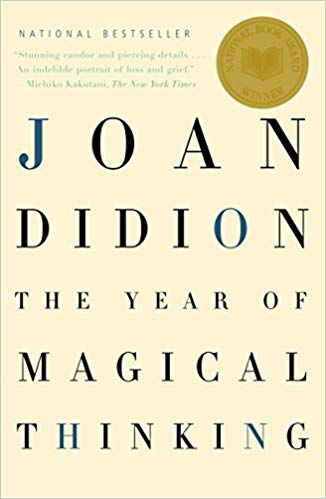
Just a few days ago, conversations about author’s craft centered around the use of short sentences in prose. I mentioned to students how powerful short sentences could be, but like many things in reading and writing, showing works better than telling. During independent reading, I asked them to collect short sentences (usually 1-4 words) form their books on sticky notes. I came to class with my own collection of short sentences from my book, The Year of Magical Thinking by Joan Didion, pictured here:
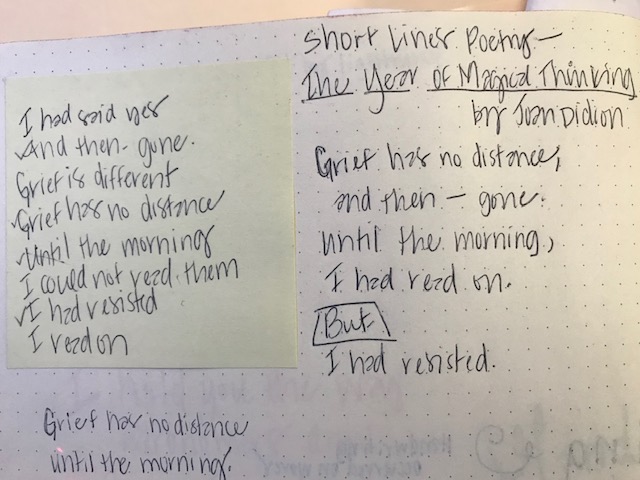


Under the document camera, I began arranging the sentences into the form of a poem, paying attention to the meanings of lines, of how fractured sentences could be fused into new ones, of how meaning changes when lines are extracted from context and blended with something else. As I arranged the sentences, I thought aloud, telling students that adding or removing words from the original sentences was acceptable.

After a few minutes of crafting in front of them, I invited them to do the same. Students worked for about ten minutes with the sentences from their independent reading. During this time, I asked them to mold them into the shape and feel of a poem, read it aloud to themselves, then revise their original poem by swapping lines, interspersing their own lines of original thought, isolating words on a single line to draw attention to them, and so on.

After collecting short sentences from Girl in Pieces by Kathleen Glasgow, Levi wrote:

I am alone.
In the house.
I let them pull me in.
Deep down.
Black as night.
Nothing in my mind.
I turn it off.
I stare at the computer.
Years goes by.
But I am not.
....... died.
In my mind.
I feel free.
But in my heart.
I am gone

The arrangement of sentences—filled with haunting lyricism—mesmerized me and his other readers.

Brittany, while reading Flawed by Cecilia Ahern, found this poem of sentences:

A light goes on for me.
I have people.
My hearing is this afternoon.
She makes a face.
I smile at her in thanks.
And then we are inside.
He tips his hat.
¨Do you agree?¨
I silently fume, then think hard.
¨Absolutely.¨
The room erupts.
I jump up.
I pass out.

The blend of dialogue gives her poem a different edge. Characters’ names were in the original version, but I encouraged her to remove them so the reader could create the voices and names. 

Finally, students shared their poems with a classmate and posted it on a class Padlet. I also shared mine.


Grief was different.
an ocean of dark
I could not read.
I had resisted,
but soon said yes,
and felt the rush
of numbing waves.
Grief has no distance
until the morning,
when streams of light
streak the sky.

Stretching Their Thinking
Creativity exploded with this activity. I wanted students to deepen their awareness of the utility of short sentences while also appreciating author’s craft. After students posted their poems on the Padlet, I gave them time to read their classmates’ poems, identifying the one they were drawn to the most. Inside their notebooks, they copied the poem and wrote their why: What caused them to choose this poem? What word or line stands out the most to them? How does this poem make you feel? Time was provided to share poems that resonated and to celebrate their craft.
I asked students to tell me how their thinking had changed about short sentences. They answered, “We had no idea short sentences could be so powerful.”

And now, they have beautiful poems and a method of reflection that they can return to again and again.

Further Reading:


Travis Crowder is a 7th grade ELA teacher in Hiddenite, NC, teaching ten years in both middle and high school settings. His main goal is to inspire a passion for reading and writing in students. You can follow his work on Twitter (@teachermantrav) and his blog: www.teachermantrav.com/blog.


2018 Poem #23 -- All Things Big and Small

by Zachary Sibel

In the world of spoken word poetry, it is hard to beat the work of Rudy Fancisco. His work is powerful, brilliant, and highly entertaining. While his videos are incredible -- and I suggest you use as many as you can -- his recently published anthology, Helium, presents a number of written texts that fit well as a warm-up in any class.

One text that I have used recently is a poem he first published via social media and later used in his book.


Find this poem in Rudy Fransisco's book, Helium, or in the original tweet.  

This poem is simple and presents an abundance of opportunities to talk about language and narrative.

Before introducing this poem, I talk to students about some fears that I have, things like flying and heights. I ask students if they have any fears and discuss whether they are rational or not. I end the brief discussion with what seems to be a surprising statement for some students: that I am terrified of spiders. I then show them this poem on my screen. I read the poem aloud and ask for a student reading.

The discussion can go a number of ways. Focus on the first half: "How does the poet react when asked to kill a spider, a task we all have probably done without giving it much thought?” Or focus on the second half of the poem: “What profound statement is made about the refusal of a simple task, killing a spider”.

I start with these questions but also allow student to just talk about the poem and what they got out of it. I close the discussion with the fact that since reading this poem a year ago, I haven’t killed a spider. Because of the way Fancisco addresses the idea of being “caught in the wrong place/at the wrong time, just being alive” I have tried to treat all things with a greater sense of kindness and mercy. Poetry can change us.

A suggested pairing: Read this text alongside William Blake's "The Fly"  and allow students to analyze “How does poetry allow us to see large concepts in the smallest of creatures?”

Further Reading:


Zachary Sibel is a hip-hop fan and an eighth-grade English teacher at Tohickon Middle School in Bucks County, PA. 

2018 Poem #21 -- Comfort Food

by Brett Vogelsinger

Everybody has their favorite comfort food. An omelette with bacon, macaroni and cheese, wonton soup, chocolate cake with vanilla icing, and a full box of Triscuits -- these are a few of my personal favorites.  

In the poem "Everybody Made Soups," poet Lisa Coffman takes an artistic eye to a favorite winter comfort food, and since winter does  not seem to want to let go of us here in Pennsylvania this year, it seems strangely apropos right now.  After a first read of the poem, I ask students to answer a single question.  What words or phrases do you find here that are most surprising to find in a poem about soup?


Everybody Made Soups
by Lisa Coffman

After it all, the events of the holidays,
the dinner tables passing like great ships,
everybody made soups for a while.
Cooked and cooked until the broth kept
the story of the onion, the weeping meat.
It was over, the year was spent, the new one
had yet to make its demands on us,
each day lay in the dark like a folded letter.
Then out of it all we made one final thing
out of the bounty that had not always filled us,
out of the ruined cathedral carcass of the turkey,
the limp celery chopped back into plenty,
the fish head, the spine. Out of the rejected,
the passed over, never the object of love.
It was as if all the pageantry had been for this:
the quiet after, the simmered light,
the soothing shapes our mouths made as we tasted.


Words and phrases like "great ships," "the story of the onion," "weeping," "cathedral," and "pageantry" consistently surprise my students.  We often end up discussing the fun choice of ending the poem with the image of "the soothing shapes our mouths made as we tasted."  I even ask them to pantomime what it looks like to eat a spoonful of soup. 

A follow-up question can help us go deeper and inspire writing: Why does the writer use words that seem almost too profound or intense for the topic?  How does this help strengthen the poem? 

For five minutes, students can write in their notebooks about a favorite comfort food, perhaps even using language that is a bit over-the-top to intensify the effect on readers.  Writing with them in my notebook under the document camera, I might zoom in on the "lava flows" when I slice open my omelette or capture the feeling of "base jumping" off the "cliff" of a three-layered chocolate cake slice.  These subtle hyperboles can make the mundane become extraordinary, and often that is the ambition of a poem in the first place. 

Further Reading: 


Brett Vogelsinger is a ninth-grade English teacher at Holicong Middle School in Bucks County, PA.  He is the faculty adviser for the school literary magazine, Sevenatenine.  Besides his annual blogging adventure on this site, he has published work on Nerdy Book Club, The New York Times Learning Network, and Edutopia and you can follow him on Twitter (@theVogelman).


2018 Poem #19 -- Student-Led Observation and Conversation

by Rose Birkhead

Hanging Fire by Audre Lorde is a perfect fit for a fourteen-year-old adolescent student!

On the day I shared this poem with my students, I rearranged the desks to form a circle. The students knew from the beginning of class that today was going to be different, and it brought a new energy to the classroom. I highly recommend rearranging the furniture to promote conversation!

I used the text rendering experience to work through this poem, and also had students write a short comment to connect with the poem, an idea in their head, or an emotion on their heart, the Book-Head-Heart from Kylene Beers & Robert Probst.

First, I read the poem aloud to the students and had the students close their eyes, or put their heads down so they could take in the poem. On second read, I passed around copies of the poem for each student, and displayed it on the board. During the second read, I asked students to underline a sentence that stuck out to them. I read the poem aloud again, and asked them to box a phrase. Finally, I had the students read the poem to themselves, and asked them to circle one word that stood out to them. We shared our sentences, phrases, and words in the traditional text rendering protocol; then I had the students have a full class discussion about the poem for five minutes. After the discussion, students wrote down a new learning from the whole class discussion.

This activity probably takes 15 minutes. The poem has so many layers of meaning, and I was impressed with how the text rendering helped students naturally make connections with the poem. During our whole-group conversation, I held back my thoughts and let the students run the conversation. Their discussion was rich and powerful. The short write after the conversation allowed students to go back and see how/if their thinking changed, and their writing was expressive and personal. Enjoy this age-appropriate poem about being an adolescent.

Further Reading:


Rose Birkhead is a Reading Specialist in Holland, PA. She teaches 7th and 8th grade literacy classes and strives to create a positive learning environment where her students feel successful on a daily basis.

2018 Poem #17 -- Save Favorite Words

by Amy Ludwig VanDerwater

I collect words.  And I keep lists of these collections in my notebooks. When I listen to people speak, read books, or think, I pause to consider the sounds and meanings of lovable and interesting words.  Just this week I've been enchanted by Albuquerque and resonant.  Last week I fell in love with seagull and periwinkle.  

We are changed when we pay attention to words, and while collecting words focuses our attention on language-music, word collections also offer writing ideas. 

Begin a list of favorite words in your own notebook.  Think about words you loved as a little child, words that call up fabric names and kitchen words.  Consider nature words or magical words.  Write these down. 


A sample favorite word list with connections.


Once you have a list, consider connecting pairs of words in surprising ways by drawing random lines between them.  If you desire, share your list with friends or colleagues, each of you saving each other's favorite words as you wish. Or simply choose one word, place it atop a page, and write from it.  You may find that the lines you have drawn will invite a curious connection that brings you somewhere new, as I did in the poem "Word Collection." 


"Word Collection" by Amy Ludwig VanDerwater

Allow yourself to be surprised.

Collect words always.  Words are the bricks of writing. 

I am grateful to Rebecca Kai Dotlich for teaching me to make and share my favorite word lists as she learned from Myra Cohn Livingston.  Pass it on.  Pass it on. 


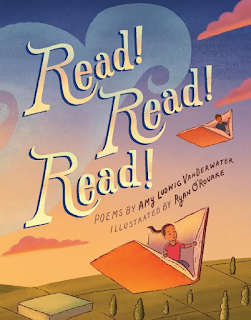
Amy Ludwig VanDerwater is author of books including FOREST HAS A SONG, EVERY DAY BIRDS, READ! READ! READ!, DREAMING OF YOU, WITH MY HANDS, and POEMS ARE TEACHERS.  Amy lives in Holland, NY with her family, blogs for young writers at The Poem Farm and Sharing Our Notebooks and posts on Twitter and Instagram as @amylvpoemfarm. 

Enter our giveaway to win a free copy of Amy's book Read! Read! Read! by leaving a comment on any 2018 Go Poems post by 8:30AM on Saturday, April 6.  Many thanks to Boyds Mills Press for sponsoring this giveaway.  

2018 Poem #8 -- The Power of Poetry

by Travis Crowder

So often, I find that students have a tenuous relationship with poetry. I expose students all year to poems, showing them how to unpack, create, and write about the things that are meaningful to them, the things that interest them. Most often, I find that students will grapple with more difficult poems if they have been given the opportunity to write their own.


Writing their own poetry, though, requires patience and guidance, especially if you work with reluctant readers and writers. I find that many students love writing in non-traditional formats, especially concrete poetry. I introduce nontraditional poetry early in the year, and as the year progresses, I give students chances to write poems that break traditional forms. I love using Allan Wolf’s writing as a starting point because he is an accessible poet, but he also deconstructs traditional forms to engage readers.  


I ask students to jot down these questions…


1. What do I see?
2. What do I hear?
3. What do I feel?
4. What do I smell?
5. What do I think?

...and begin adding their thinking.


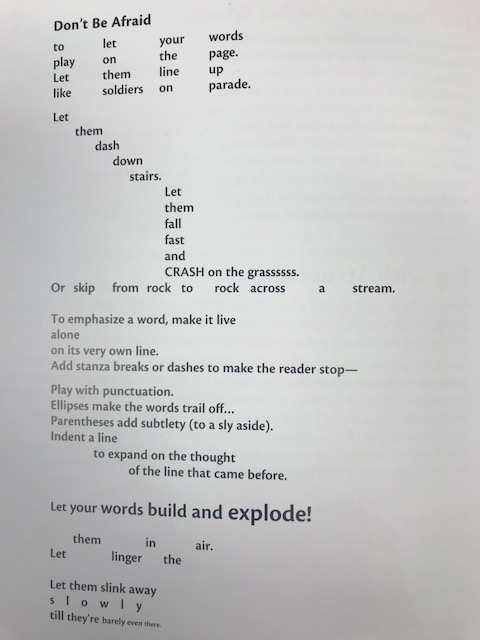
Afterward, I display "Don't Be Afraid" by Allan Wolf. It is a segment from Immersed in Verse, a beautiful book of lyricism that invites any writer into the world of writing poetry.

Image taken from Allan Wolf's website, linked above. 

For a few minutes, we discuss how Wolf modifies font size, style, and spacing to match topics and ideas within his poems. Students are always mesmerized by the variations in style and are eager to create their own.


So I let them. And they use the things they saw, heard, felt, smelled, and thought as the foundation for their poems.   


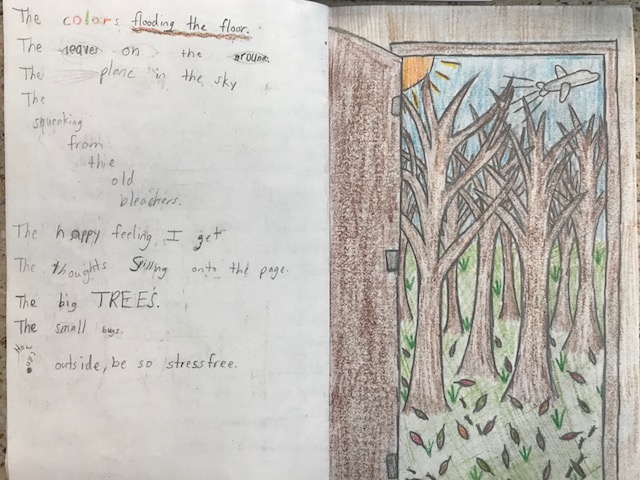
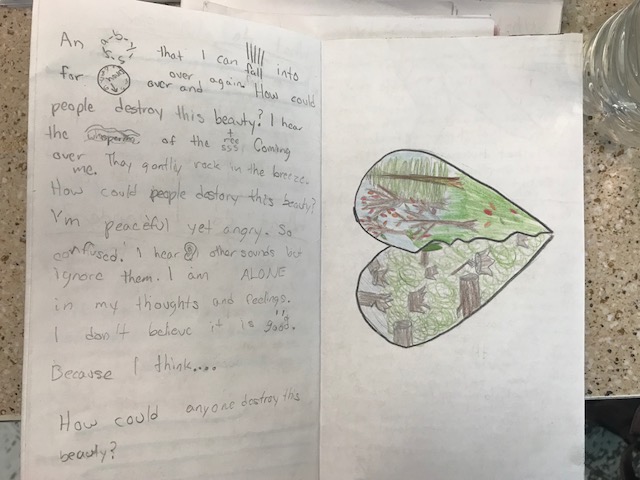
I give them time to play with language, with style, with spacing, and with imagery, much like the poem from Allan Wolf. It is here that students begin to understand purpose, tone, and how poetry can push us past the ostensible. Give them a chance to create. And be prepared to stand in awe of their creations, such as the examples below:


Further Reading:


Travis Crowder is a 7th grade ELA teacher in Hiddenite, NC, teaching ten years in both middle and high school settings. His main goal is to inspire a passion for reading and writing in students. You can follow his work on Twitter (@teachermantrav) and his blog: www.teachermantrav.com/blog.

2018 Poem #7 -- A Poem as a Word Bank

by Brett Vogelsinger

Some student writers struggle to access their full vocabulary while in the frenzy of a first draft or the more attentive work of revision.  Since poems are filled with strong diction and fresh uses for familiar words, a poem can actually be sourced as a bank full of powerful language.

The poem "The Last Movie" by Rachel Hadas is more than just a poem about a movie.  It is poem about coping with impending loss.  After a first read, of this piece, it is vital to ask students, "In addition to a movie, what else is this poem about?" before trying to mine the language from these powerful stanzas.  

Recently, before watching the trial scene from the black-and-white movie To Kill a Mockingbird, I asked students to choose one actor to study closely so that they could write a review of that actor's performance.  We had already read "The Last Movie" at the start of class, but after watching the scene, I invited students to find five words in this poem that they might use in writing their review.  The resulting reviews contained lines like "Mr. Ewell's look was opaque as he realized . . . that Atticus was doing a great job," or "Rather than spewing fury against Mayella Ewell or Bob Ewell, Peck continues to be the person who brings reason to the trial."  Students put the words to work to create an authoritative voice in their reviews.


Of course this principle has far broader application.  Before a draft day for an argument piece or a lit analysis, read a poem that is particularly rich in its diction, the"chocolate mousse" of word choice, and have students find just a few words to create a word bank.  These should not be mandatory to use in a draft, but the challenge of using a seemingly unrelated but interesting word often opens doors to more vibrant sentences.

P. S. Thanks to Bryce and Rebecca for letting me use their writing samples in this piece.

Further Reading:


Brett Vogelsinger is a ninth-grade English teacher at Holicong Middle School in Bucks County, PA.  He is the faculty adviser for the school literary magazine, Sevenatenine.  Besides his annual blogging adventure on this site, he has published work on Nerdy Book Club, The New York Times Learning Network, and Edutopia and you can follow him on Twitter (@theVogelman).


Go Poem #28 -- Burning The Old Year

by Brett Vogelsinger

Naomi Shihab Nye's poem "Burning the Old Year" showed up in my inbox on January 2, 2017, thanks to the amazing poetry teaching resources from The Academy of American Poets, available here and searchable via #poetryclassroom.  The email included some classroom activities, which are excellent for starting a new calendar year, but as all teachers are wont to do, I began thinking about how to modify or adapt the listing idea so that this poem could have relevance any time of the year.

Ultimately, the poem is about what things perish quickly -- "lists of vegetables, partial poems" -- and what lasts -- "so little is a stone."

In their notebooks, I have my students sketch a fire for one minute while thinking about what aspects of life survive the "orange swirling flames of days" and what aspects do not.  Then we make two lists.  What things do we quickly relinquish in life, and what do we manage to cling to, sometimes despite wishing to let go.  What is "paper" in our life and what is "stone?"

These two lists can provide rich ideas for later writing topics, so students can nurture this seed into their own creative writing if they wish.

Also, don't miss Naomi Shihab Nye's excellent speech about teaching poetry:


Brett Vogelsinger teaches freshman English students at Holicong Middle School in Doylestown, PA where he starts class with a poem each day. Follow his work on Twitter @theVogelman.

Further Reading:


Go Poem #27 -- Wreck This Poem

by Brett Vogelsinger

As teachers of poetry, we have likely all spoken about the value of each word in a poem.  It is no hyperbole to say that each word in a poem carries more weight than each word in an essay, short story, or novel.  But to make this fact have a bit more impact, and in the spirit of Keri Smith's wildly successful creative journal series, it can be fun to experiment with "wrecking" a poem.

Anne Porter's Poem "Wild Geese Alighting on a Lake" is a poem that students can easily identify as tranquil in its mood.  I challenge students to wreck the poem in their Writer's Notebooks by drastically altering its mood.  They must do this by changing only five words.

Fair warning: if you try this in class, a fair amount of students will kill off those geese.  Nonetheless, the outcomes are remarkable.  A poem that is nearly the same can be so, so, incredibly different when the writer (student) alters just five of the writer's (poet's) words.  Your class is guaranteed a few laughs along the way, and we can only hope that Anne Porter would forgive and maybe even applaud the kids' irreverent ingenuity.

An interesting extension might include a discussion of the connotations of those five changed words, for it is the associations of the individual words that help to craft the mood in a poem.

Brett Vogelsinger teaches freshman English students at Holicong Middle School in Doylestown, PA where he starts class with a poem each day. Follow his work on Twitter @theVogelman.

Further Reading:

Living Things: Collected Poems by Anne Porter


Go Poem #22 -- Mood Music

by Lisa Levin

Musician Jeff Tweedy recently turned Carl Sandburg’s poem “Theme In Yellow” into “an airy, idyllic folk song” that appears on Brooklyn musician David Nagler's tribute album, Carl Sandburg's Chicago Poems.


The poem describes a midwestern October and is filled with images of "prairie cornfields / Orange and tawny gold clusters" and children "singing ghost songs / And love to the harvest moon" while gathered around a pumpkin (or someone pretending to be a pumpkin), who serves as the poem's speaker.


I project the text of this poem on the screen while my students listen to the song. I tell the students very little beforehand, except that they should try and ascertain whether the poem develops a story from the images the poet creates. After the song, I ask a student to volunteer to read the poem to the class. Next we discuss the literary element of mood. Students define the mood of the poem and then provide lines from the poem as supporting evidence. It was interesting that half of the students found the mood to be peaceful and half found the mood to be sinister!

Lisa Levin teaches ninth-grade English at Holicong Middle School in Doylestown, PA.


Further Reading:


Go Poem #21 -- A Seasonal Switch-Up

by Brett Vogelsinger

National Poetry Month is a harbinger of warmer weather in many parts of the United States, and most people who experience the bitter extremes of a frigid winter are ready to bid that weather farewell.  Reading the poem "Night Below Zero" by Kenneth Rexroth might seem counterintuitive.

The poem beautifully captures the way "the cold lies, crystalline and silent" in the dead of winter, which can introduce an intriguing challenge for your students.  Can they craft a short, sharp poem like this one that captures the awakening of new life with the first warmth of spring?

When the first beautiful weather strikes in Pennsylvania, I share with my students the line from Gerard Manley Hopkins' poem, "Spring": "when weeds in wheels spring long and lovely and lush."  How amazing is the rhythm and alliteration in that line!  But I digress.

Why not take the poem's title in today's poem, "Night Below Zero" and change it to something in the same concise structure that captures a key element of spring in your community:  "Sunrise Before Alarm Clock" or "Buds Upon Trees" or "Sunshine On Shoulders" (not quite the John Denver song title, but close).  This copy-change technique can be used to help coach students with mentor texts in all sorts of genres.

The same way Kenneth Rexroth uses the action of skiing in the darkness to take the pulse of a season, challenge your students to quick write for five minutes in their notebooks to their title, perhaps just focusing on one key moment or activity that characterizes springtime.  Pencils moving for five minutes will result in a draft; there is always time to go back and revise later, and perhaps you will even choose to grow this seed writing into a lesson on revision.

Brett Vogelsinger teaches freshman English students at Holicong Middle School in Doylestown, PA where he starts class with a poem each day. Follow his work on Twitter @theVogelman.


Go Poem #17 -- A Wordsplashed Poem

by Brett Vogelsinger


I use this image, created on Wordle, to project a wordcloud of the language from the poem "Turtle" by Kay Ryan onto the screen. Students predict what today's poem will be about. Sometimes I even tell them that the title is hidden in the word cloud. 

Naturally, as in most poems, some of these words have figurative meaning.  After reading the poem twice, we discuss which nouns are used literally and which are used figuratively.  What does the use of these figurative nouns add to the poem?  Why use figurative language as a writer?  What does it add to the experience of readers?


Brett Vogelsinger teaches freshman English students at Holicong Middle School in Doylestown, PA where he starts class with a poem each day. Follow his work on Twitter @theVogelman.


Further Reading:


Go Poem #15 -- "All Nouns and Verbs"

by Brett Vogelsinger

One of my favorite (and perhaps the truest) quotes about poetry is from Marianne Moore and serves as the title of today's post.  "Poetry is all nouns and verbs."  Pick your favorite poem and look at it closely.  Your favorite words, the pieces that really make it tick, will be the nouns and verbs.


Many students know the poem "dog" by Valerie Worth when they come to me because it was memorably used in the short novel Love That Dog by Sharon Creech. My students have frequently read this book in late elementary school.  Now we examine it in a different way. 

After the first read, I ask them to count how many verbs they can find.  Following this initial census, I have the kids start calling them out while I circle the verbs on the screen.  Instead of giving the poem our customary second reading, this time I only read the title and the verbs.

Does the poem still work? Can you still get a similar picture, even if we use just the title and a list of verbs?  Why is this?  What makes action verbs so powerful for vivid writing?  Sometimes students associate adjectives with helping the reader see something in their writing.  Why can verbs be just as effective, if not more so, in helping readers visualize a scene? 

What I love about this activity (beside the brevity and straightforwardness) is that it blends in a review of parts of speech and provides a skill that can be extended to any genre, for essays and short stories are just as improvable as a poem is when the writer gives full attention to the verbs during revision.

While this activity focuses on verbs, consider using Jeff Anderson's idea, published previously on this blog, to focus on the power of nouns.  

Brett Vogelsinger teaches freshman English students at Holicong Middle School in Doylestown, PA where he starts class with a poem each day. Follow his work on Twitter @theVogelman.


Go Poem #11 -- Experiencing a Poem

by Pernille Ripp

My classes read the poem “Hugging Jose” by Jason Reynolds because they love the work of Jason Reynolds, and also because it shows poetry from a different standpoint.  Not the traditionally viewed version of poetry, but instead one that is written to evoke emotion and help students connect to the form of poetry.


I read it aloud while the students follow along and then in small groups I have them discuss the following questions:


Who is the person writing it?
Who is he writing it for and why?
How can you relate to this poem?
How do you feel after reading this poem?


A big part of our focus whenever we discuss poetry is looking at how language is used to evoke emotions and so we do not analyze poetry in the traditional sense, but instead reflect on what mood we are in as readers after experiencing a poem.  Which words are powerful to us and why?  The answers vary from group to group, and I think this is so important to emphasize with the kids; there is no right answer but instead answers based on our experience.  

I wrap the lesson up by asking about the end message -- the final two lines of the poem -- what does Jason Reynolds want us to walk away with?  This poem speaks to many of my kids, not all, but I think it offers a way to show them that poetry might be more raw than they assume.

Pernille Ripp is a seventh-grade language arts teacher from Madison, WI. Follow her work on Twitter: @pernilleripp


Further Reading:


NewSmsPunch | Send Free Sms Online in Pakistan | Comedy | Good Morning | Adult | Romantic | Birthday © 2012 | Powered by chattinghome.blogspot.com Specially Made for public chat rooms